
Automail as Inspection Management
From inspection bookings to quality decisions and reporting, Automail coordinates suppliers, inspection companies, and internal quality teams without replacing the company's ERP.
Balancing inspection cost and product quality
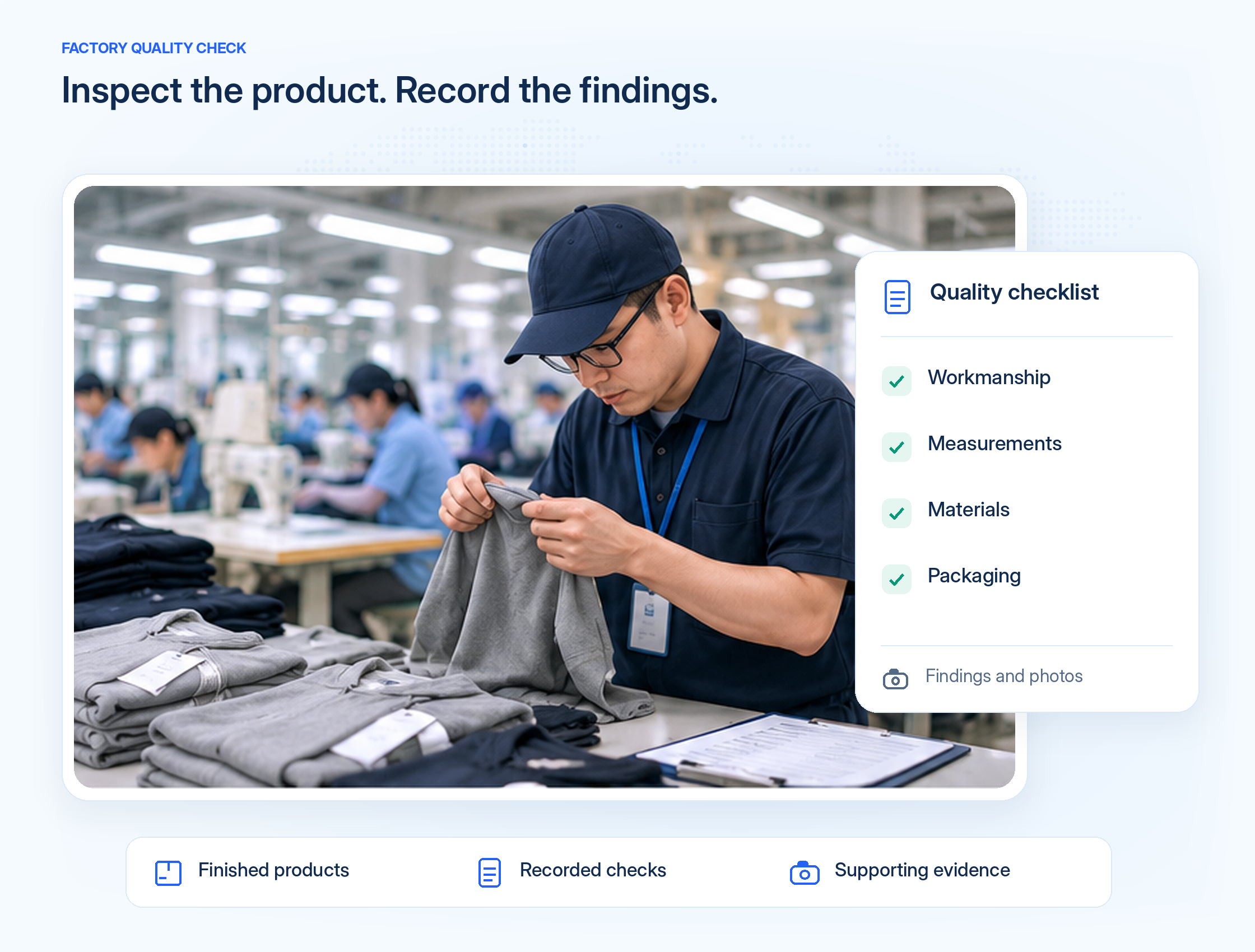
Before finished products are shipped, companies need to decide whether an inspection is required, who should perform it, and whether the results meet their quality standards.
There are three possible routes: third-party inspection (3PI) by an independent inspection company, self-inspection (SI) by qualified supplier staff, or no inspection (NI) when an order is eligible to ship without an on-site inspection.
The goal is to reduce unnecessary third-party inspections while maintaining enough oversight to prevent defective products from reaching customers and damaging the brand.
Because supplier-led inspections are less independent, the allocation between 3PI, SI, and NI needs careful control. The decision cannot simply be left to suppliers.
3PI / Independent
An external inspection company checks the products.
SI / Supplier-led
Certified supplier staff inspect their own production.
NI / No inspection
Eligible orders proceed without an on-site check.
When a standard inspection platform is not enough
There are many capable inspection management platforms. For companies with standardized requirements across business units, a dedicated platform can be a good choice.
But inspection rules can differ at a very detailed level between product categories, teams, and regions. Booking requirements, allocation formulas, pass/fail criteria, and approvals may all vary. Fitting these into a rigid system, particularly when ERP integration is required, can become a large project.
Automail takes a more flexible approach. Its modules are configured around the company's existing rules, with forms, calculations, and approval steps that can be adjusted as requirements change.
Standard platform approach
- Align teams with predefined inspection steps.
- Adapt detailed rules across business units.
- Connect ERP data and external participants.
Automail workflow layer
- Keep existing quality rules and ERP systems.
- Configure allocation and pass/fail logic by business unit.
- Collect bookings and inspections through Autoform.
From ERP orders to the right inspection route
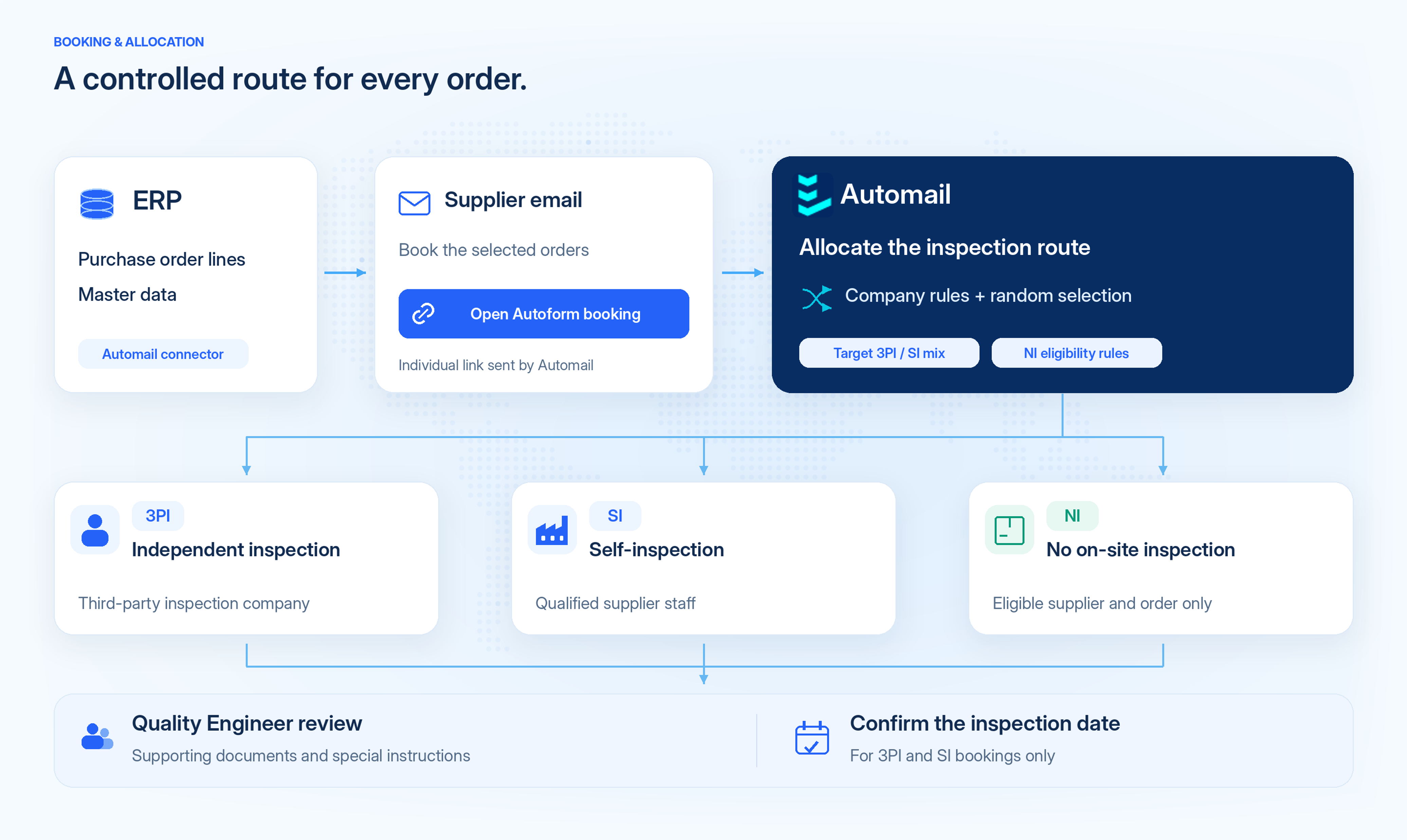
Automail connectors collect purchase order lines and the required master data from the company's ERP. Suppliers then receive emails with unique Autoform links to book inspections for the relevant orders.
Once a booking is submitted, a configurable statistical formula with a random element determines whether the order goes to 3PI, SI, or NI. It aims for a target balance between third-party and self-inspections, while allowing NI only when both the supplier and the order meet the eligibility rules.
The random element makes inspection selection difficult to predict in advance. Quality Engineers can then review bookings, add supporting documents or special inspection instructions, and confirm the next steps. For orders requiring inspection, inspectors arrange and confirm a date.
Orders and master data.
Supplier Autoform links.
3PI, SI, or eligible NI.
Checks and special instructions.
Inspector scheduling.
From the inspection checklist to an approved result
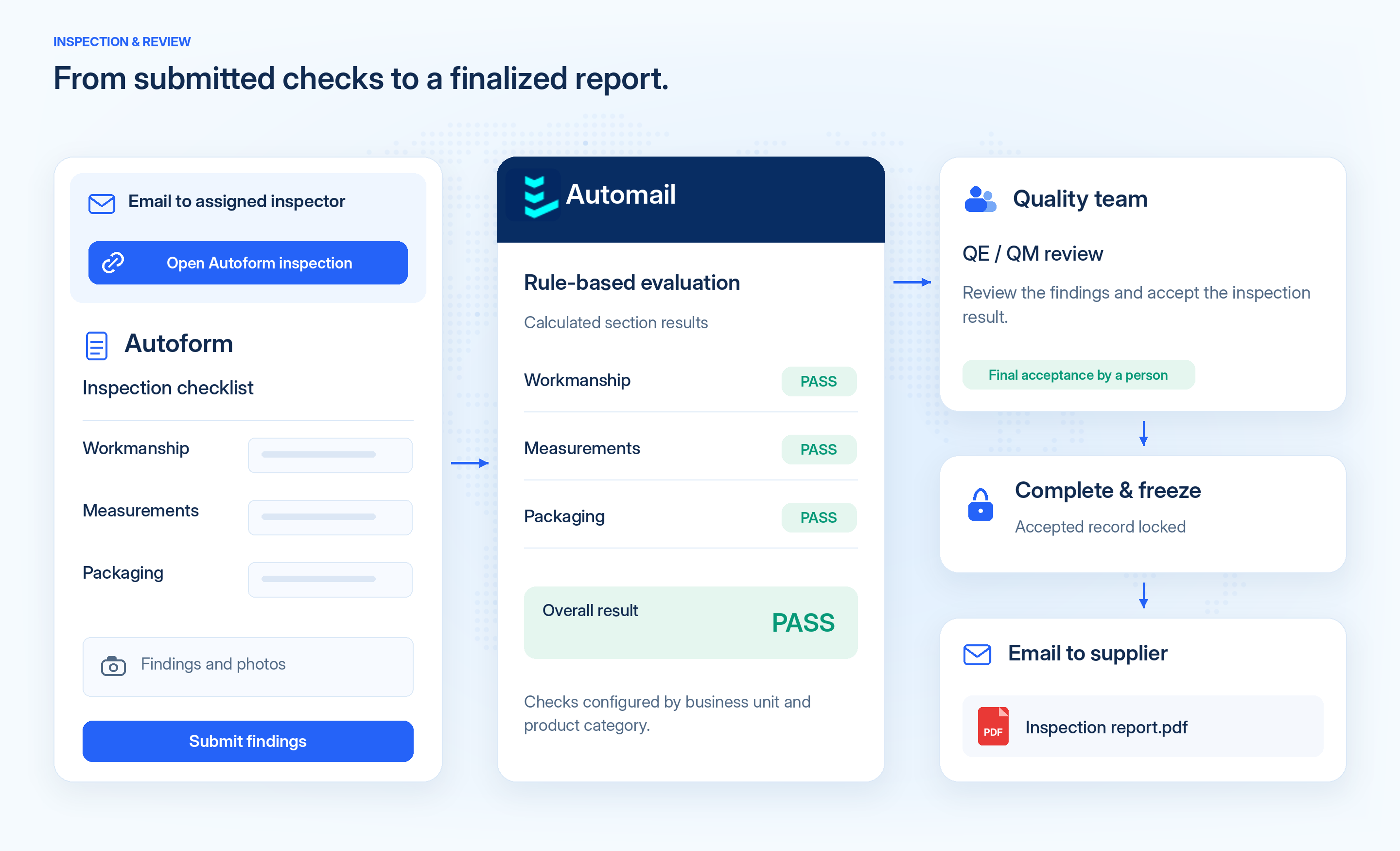
On the scheduled date, the inspector from a third-party company, or a certified supplier employee for SI, completes an inspection form through Autoform. The form captures the checklist, findings, and supporting information.
Automail checks the submitted answers using company-specific rules, calculating pass/fail results for each section and for the inspection overall. Those rules may vary by business unit and product category, so they are configured to match how the quality team works.
Quality Engineers and Quality Managers review the results in Automail. Once an authorized user accepts them, the inspection is marked complete and the record is frozen. The supplier receives the resulting PDF inspection report by email, which can support shipment release or payment under the company's existing procedures.
Separate applications for external parties and internal teams
Autoform is the external data-collection application used here for both inspection bookings and inspection checklists. Automail configures the forms, prefills available information, sends individual links by email, and retrieves submissions.
Suppliers and inspection companies complete their assigned forms through Autoform. They do not need accounts or access to Automail, which remains a separate application for authorized company users.
Quality Engineers and Quality Managers use Automail to manage bookings, monitor inspection status, review findings, and make approval decisions.
Connected to ERP in both directions
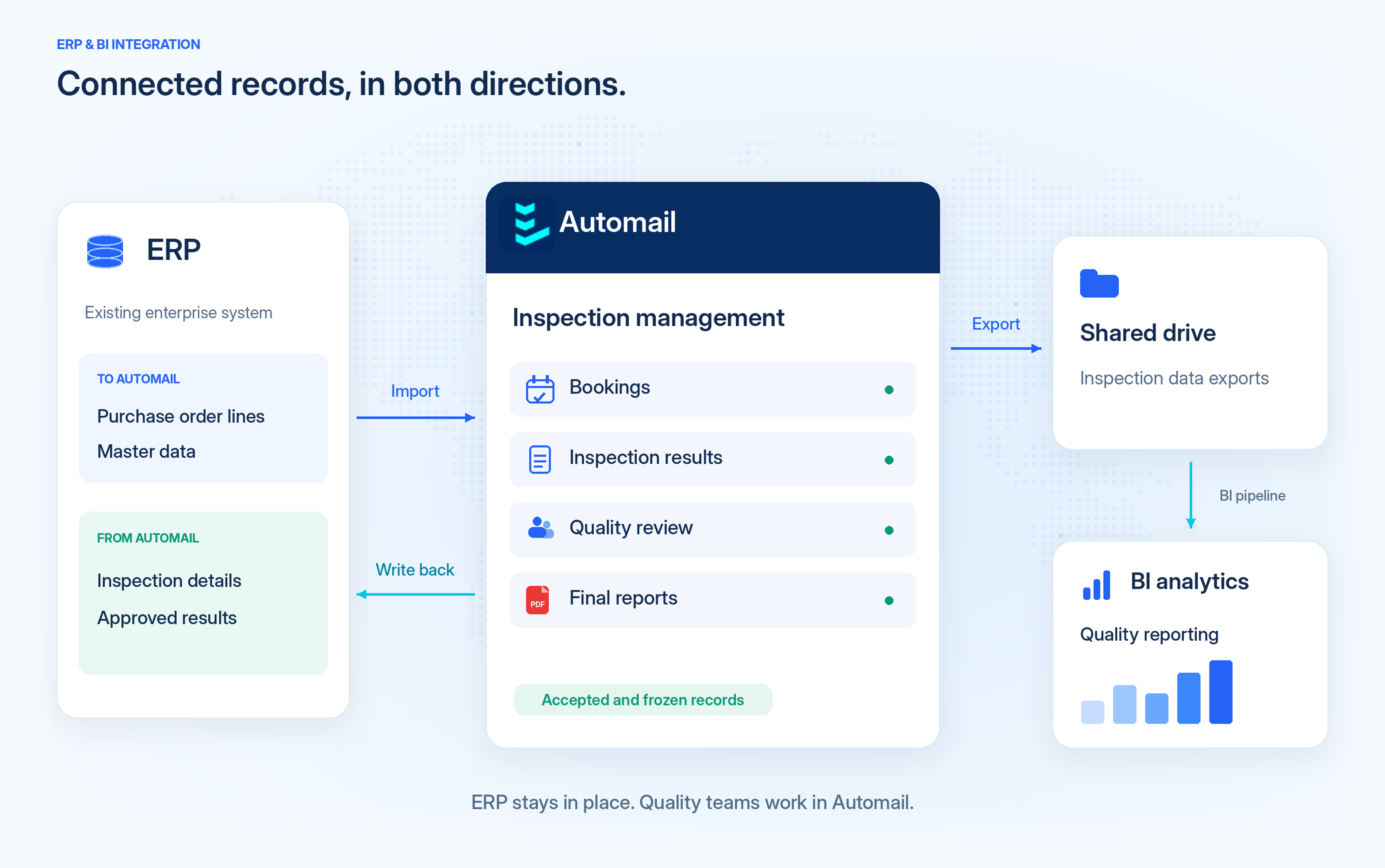
ERP integration does not stop at importing orders. Once inspections are completed and approved, Automail sends the relevant inspection details and results back to the ERP.
The collected data can also be exported to shared drives used by the company's BI pipelines, allowing analytics teams to build their own reports and monitor quality performance across suppliers and product categories.
Automail handles the daily coordination and reviews, while ERP and BI systems retain their existing roles.
More efficient inspections, without losing quality control
The result is a connected inspection operation spanning several Automail modules. It reduces manual coordination, supports more selective use of third-party inspections, and gives quality teams one place to review and manage decisions.
Controlled allocation
Balance 3PI and SI against quality risk, with NI only where permitted.
Easy for partners
Book and inspect through links without entering Automail.
Consistent reviews
Apply detailed checks while keeping final decisions with quality teams.
Connected records
Share approved results with ERP and existing BI pipelines.
Automail bridges existing enterprise systems and external inspection partners, while giving Quality Engineers and Quality Managers centralized control over the full inspection cycle.
Have a complex inspection process?
Show us your booking rules, inspection formats, and existing systems. We can discuss how Automail would fit around them.