Upstream Traceability
Trace selected materials in a finished product to the most upstream suppliers and raw-material sources, then validate the disclosed network.
From finished product to raw-material source
For a finished product, the brand usually knows its Tier 1 manufacturer and nominated Tier 2 and Tier 3 suppliers. Beyond those relationships, particularly for raw materials, visibility is often limited.
Tracing starts with the product's key materials and follows each one through the upstream mills, processors, and producers until the relevant raw-material source is identified. This may involve several additional supplier tiers.
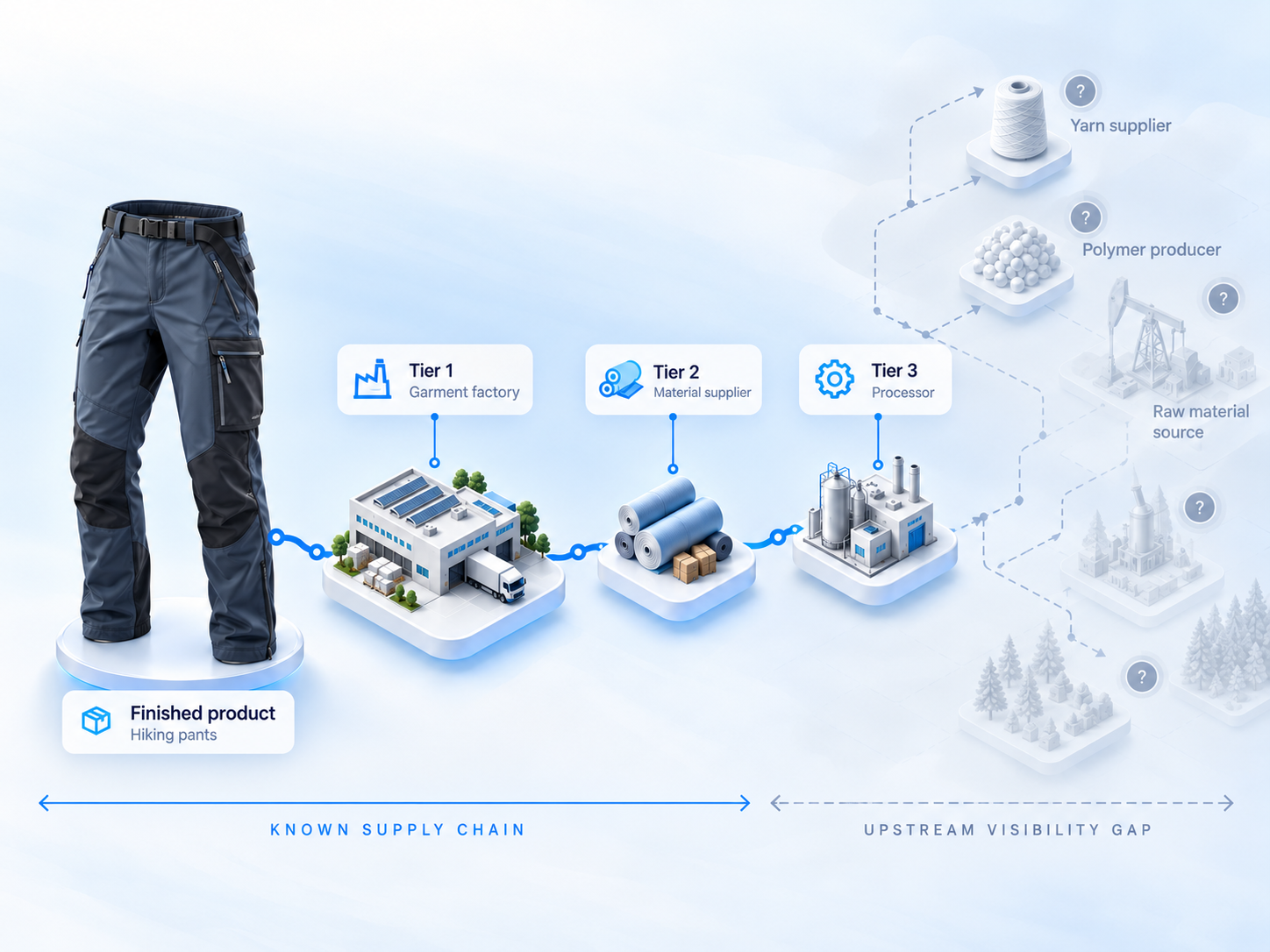
Why upstream visibility matters
Sustainability teams need to assess where materials come from and whether sourcing meets environmental, social, and labor criteria. Compliance teams also need to understand legal and trade risks beyond direct suppliers.
Materials may pass through facilities linked to environmental harm, labor or human-rights violations, or practices that do not meet the brand's standards. There may also be indirect exposure to suppliers or owners subject to US, EU, or other sanctions and restricted-party measures. These connections can sit several tiers upstream.
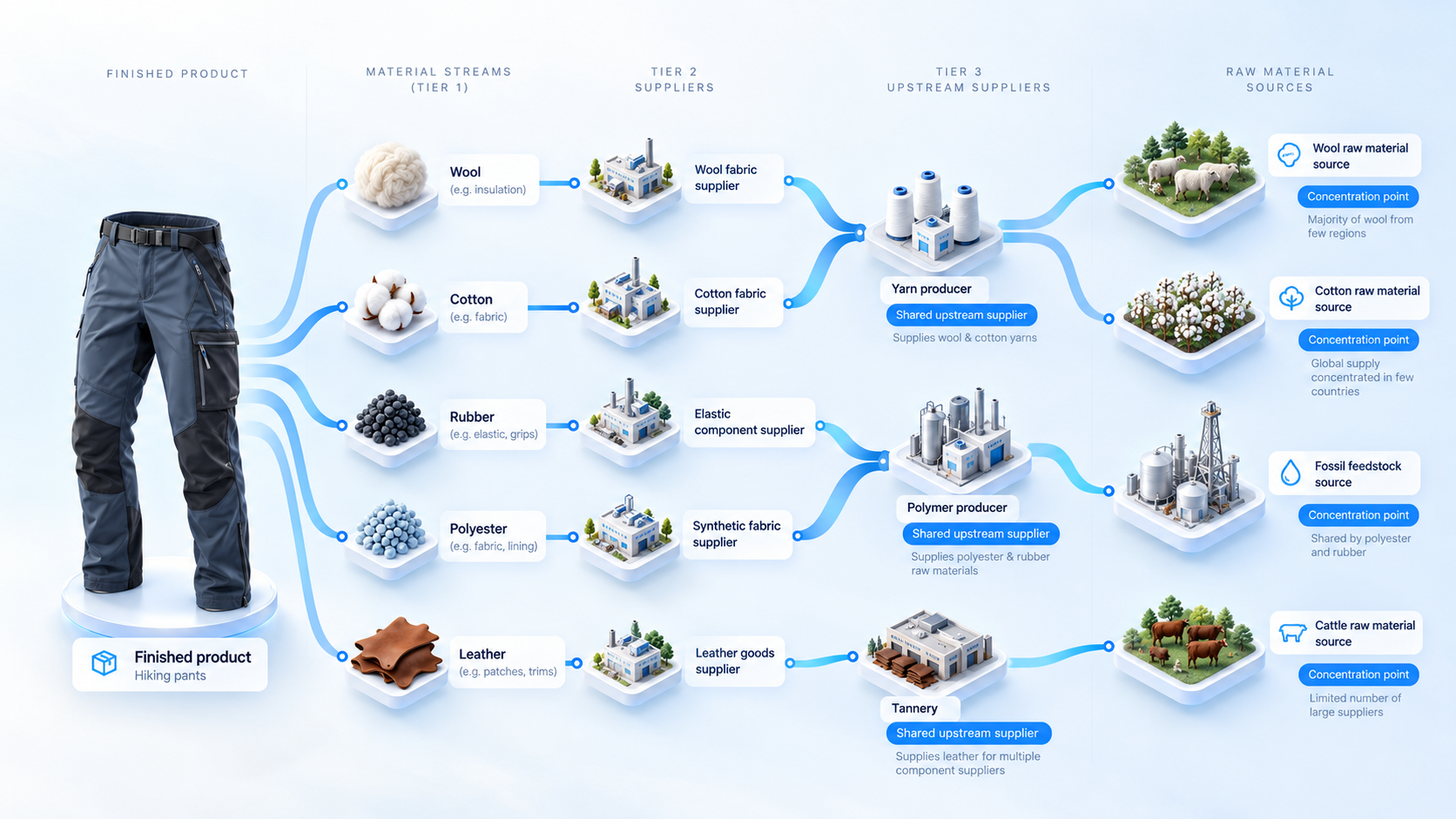
Traceability also reveals concentration risk. Several independent fabric mills may all rely on the same polyester yarn producer. The brand appears to have a diversified supplier base, but further upstream it may depend on only one facility.
Sustainability & compliance risk
Identify facilities to review against environmental, social, and labor requirements, as well as applicable trade restrictions.
Concentration risk
See where different downstream suppliers trace back to the same upstream mill, processor, or raw-material source.
Many tools exist. Supplier participation is still difficult.
Traceability is a crowded software area. In an earlier market review, we identified more than 100 providers offering related solutions.
The approaches are different. Some provide centralized platforms where suppliers log in and maintain traceability data. Others are mainly data providers, or offer investigation, verification, and on-site audit services. These can all be useful, but the centralized platform model has a practical scalability problem: every additional upstream supplier is expected to join and use another system.
The further upstream the request goes, the weaker the direct relationship with the brand. A supplier that may not even know the finished-goods company has little reason to create an account and regularly maintain data for it.
Centralized platform model
- Each supplier needs an account.
- Even occasional users require onboarding.
- Far-upstream suppliers have little direct incentive to participate.
- More tiers mean more users and more data maintenance.
Automail workflow layer
- Send requests by email with a unique Autoform link.
- Ask only for the information needed at that stage.
- Use the direct downstream supplier to support follow-up.
- Repeat the same process across tiers and material streams.
Recursive supplier disclosure
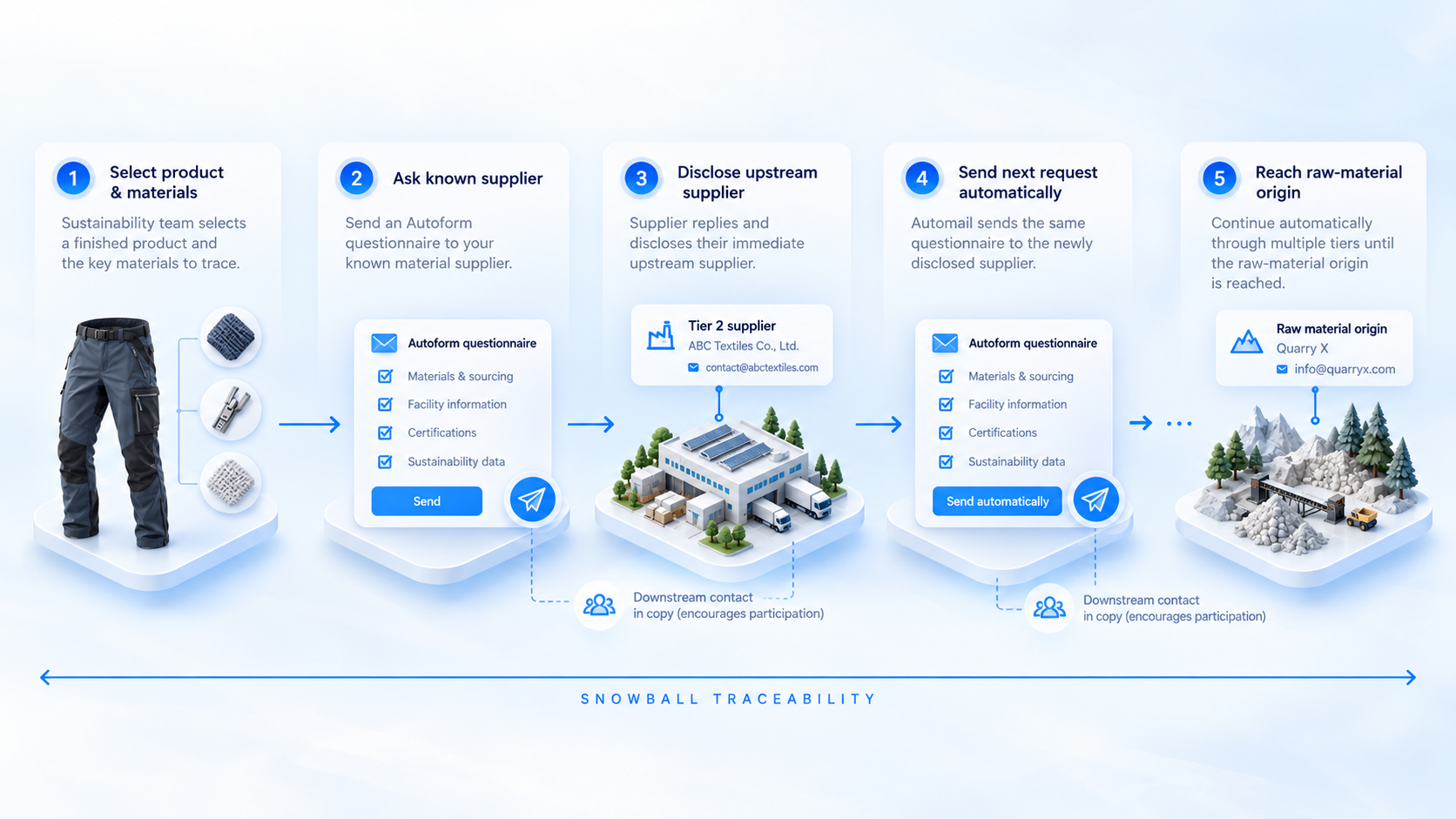
Automail uses its questionnaire module for recursive supplier disclosure. The sustainability or compliance team selects the finished product and its key materials, then starts with the suppliers already known.
Each supplier answers a questionnaire and discloses all immediate upstream facilities used for the material, including their names and contact email addresses. Automail sends the same request to each newly identified facility.
Each disclosed facility may identify several direct upstream suppliers. Automail contacts each of them and repeats the process, building the network tier by tier until the relevant raw-material sources are identified.
Choose the finished product and key materials.
Send the first questionnaire for each material stream.
Capture one or more immediate upstream facilities.
Automail contacts each newly disclosed facility.
Repeat until the relevant raw source is identified.
Getting upstream suppliers to respond
Far-upstream suppliers often do not know the brand behind the finished product. A request arriving directly from that brand can therefore be easy to ignore.
Automail copies the supplier's direct downstream customer on the request and asks that downstream party to help encourage the response. This gives the upstream supplier context and links the request to an existing commercial relationship.
No account is required. The supplier opens the Autoform link, completes the questionnaire, and submits.
Higher response rates across rollouts.
Across different customers, response rates were substantially higher than with the previous manual process, where team members repeatedly emailed, called, and followed up with individual suppliers.
Supplier recognition
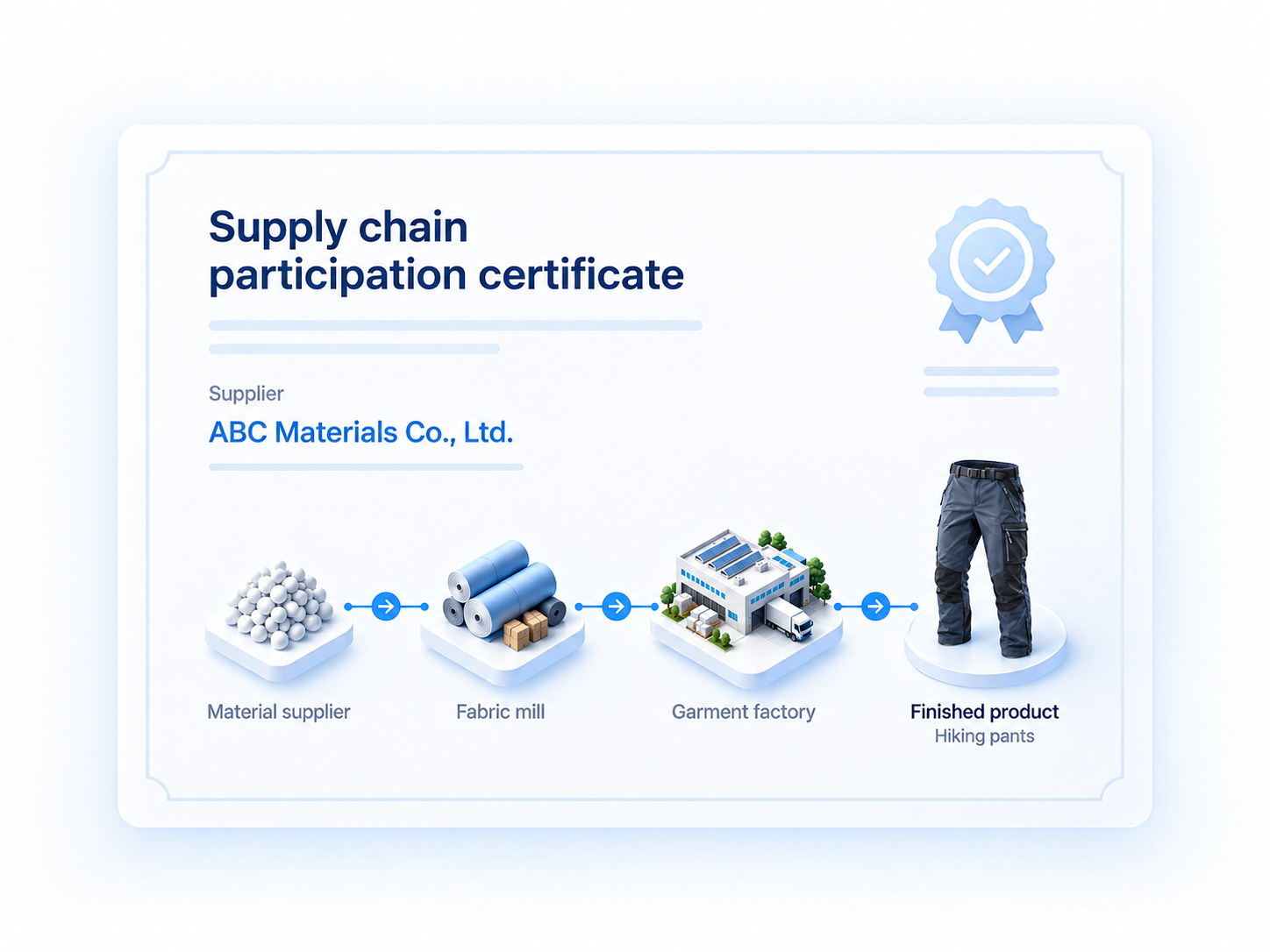
A certificate showing the supplier's role in the finished product's supply chain.
Once a supplier has submitted its disclosure and the data has been validated, Automail can automatically issue a PDF participation certificate.
The certificate includes a chart showing how the supplier's material reaches fabric mills, manufacturing facilities, and the finished product. This is useful for upstream suppliers that do not deal directly with the brand.
Validate disclosures against the supplier master
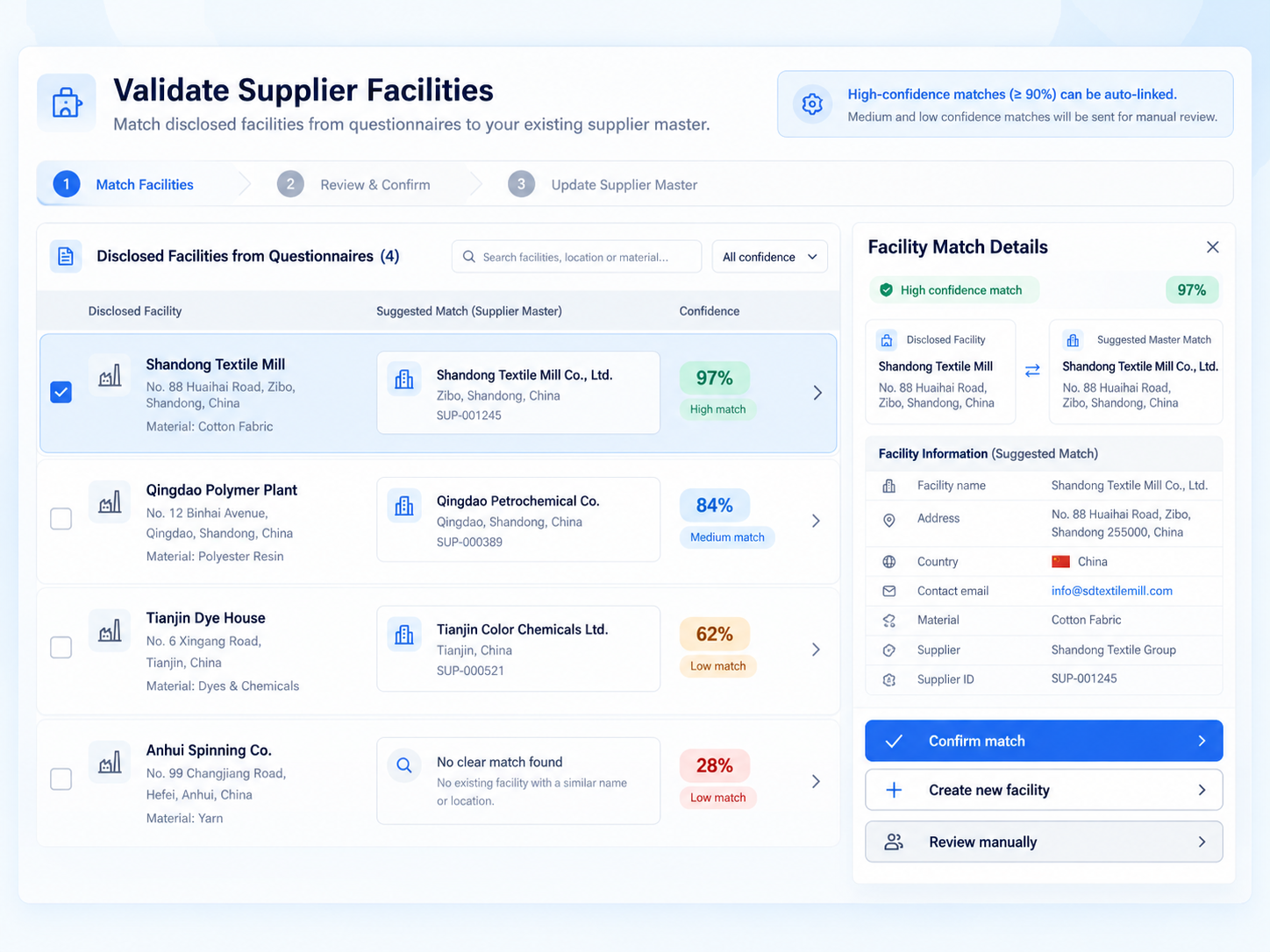
Supplier and facility names are not entered consistently, so disclosed facilities need to be matched against the supplier master before the network is considered validated.
Automail uses multi-field matching across the available identifying data. High-confidence matches can be linked automatically. When confidence is not high enough, the most likely matches are presented to the user for confirmation. Existing records can be enriched with missing details; new facilities can be added to the master.
Once a facility has been validated, the same identity can be reused when it is disclosed again by another downstream supplier. This avoids duplicate supplier records and unnecessary repeat requests.
One facility, one identity
Different suppliers may disclose the same facility under slightly different names. Validation keeps one usable master record.
Master data improves with use
Validated disclosures can fill missing address, contact, and facility information in the supplier master.
The network expands, then converges
Before the first deployment, we expected the upstream network to widen at each tier as suppliers disclosed additional facilities.
In several deployments, the network instead formed a roughly diamond-shaped pattern: it widened through intermediate tiers, then narrowed again where different branches led to the same mills, processors, or raw-material producers.
The pattern varies by material. Across our apparel, footwear, and accessories deployments, we have traced materials including wool, cotton, rubber, polyester, and leather. Some networks continue to expand while others converge much earlier, revealing upstream concentration that is not apparent from the nominated supplier lists. The hiking-pants illustration below uses fabric, zippers, elastic, and thread.
The result: a validated upstream network
The result is a validated network linking the selected finished product and materials to the relevant upstream facilities and raw-material sources. Sustainability and compliance teams can review the actual network, identify risky facilities, and see where apparently separate sourcing branches converge.
Multi-tier visibility
Trace beyond known Tier 1, Tier 2, and Tier 3 relationships.
Risk signals
Identify facilities and sourcing relationships that require review.
Reusable supplier data
Reuse validated facilities across products, materials, and future traces.
Concentration visibility
See when different sourcing branches depend on the same upstream source.
Digital product passport
The validated traceability network can also be used to create a product-level passport.
Automail can assemble and issue a digital product passport linked to a product identifier. It can bring together material composition, upstream facilities and origins, and supporting supplier documents in one structured record.
The passport can be shared through a product-specific link or QR code, or exported to another system. Fields and validation rules can be configured for the product category and the customer's reporting requirements, with the record updated as new supplier information is validated.
Trace the most upstream suppliers
Start with a finished product, the materials to trace, and the supplier data already available. Automail handles the upstream collection, facility validation, and network build-up.